
Last updated September 23, 2026
Whole-system duct and dryer vent check with before-and-after photos - you see exactly what came out of your vents
That "$99 whole-house special" is a bait ad - the real number appears once they are in your hallway, or the "clean" is a shop-vac at the register. We photograph the inside of your ducts before and after instead.
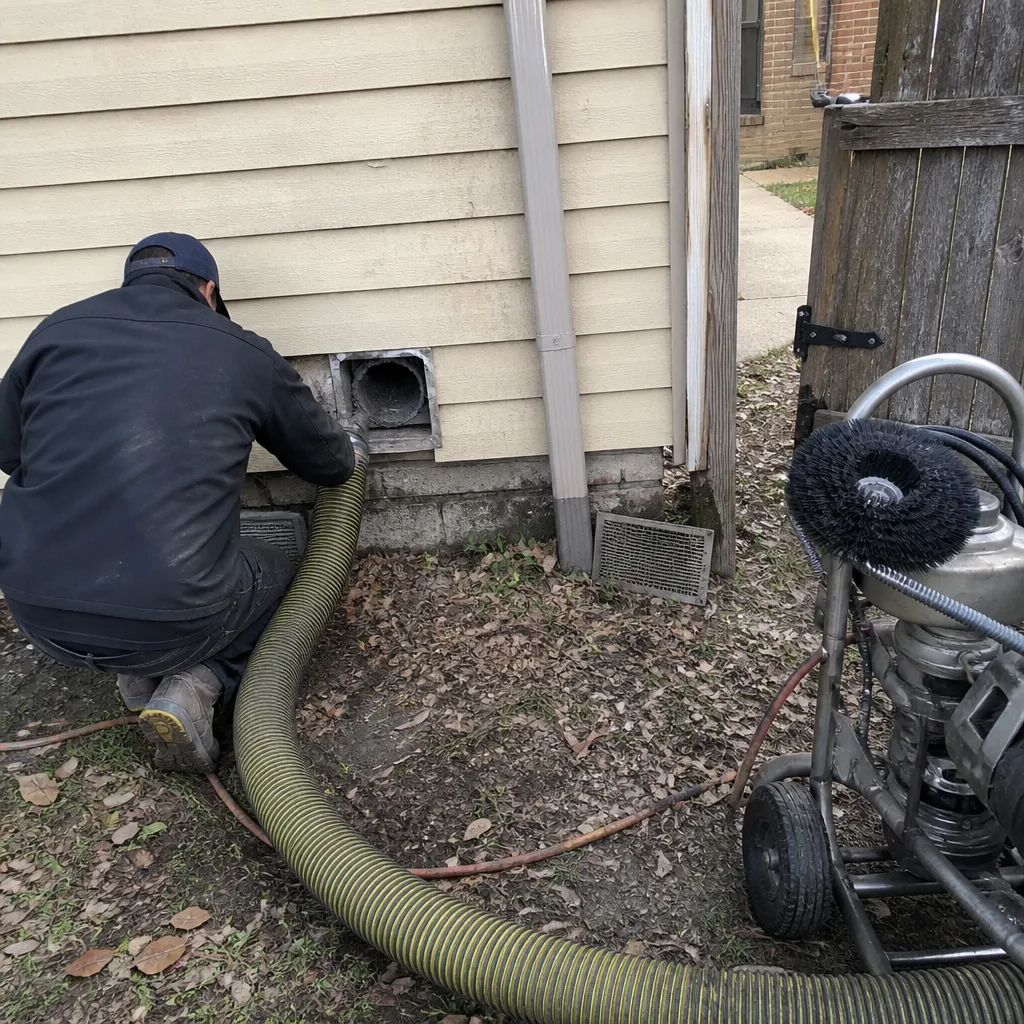 Before
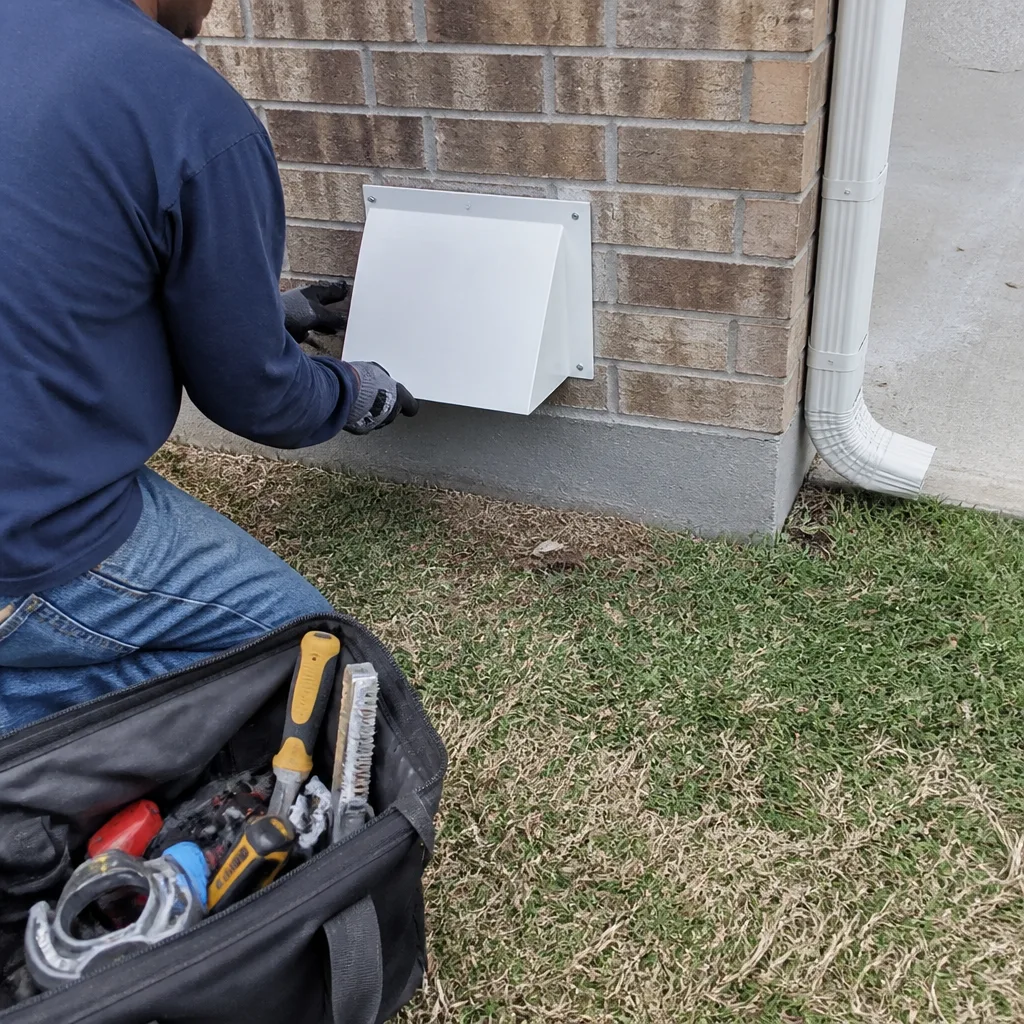 After
After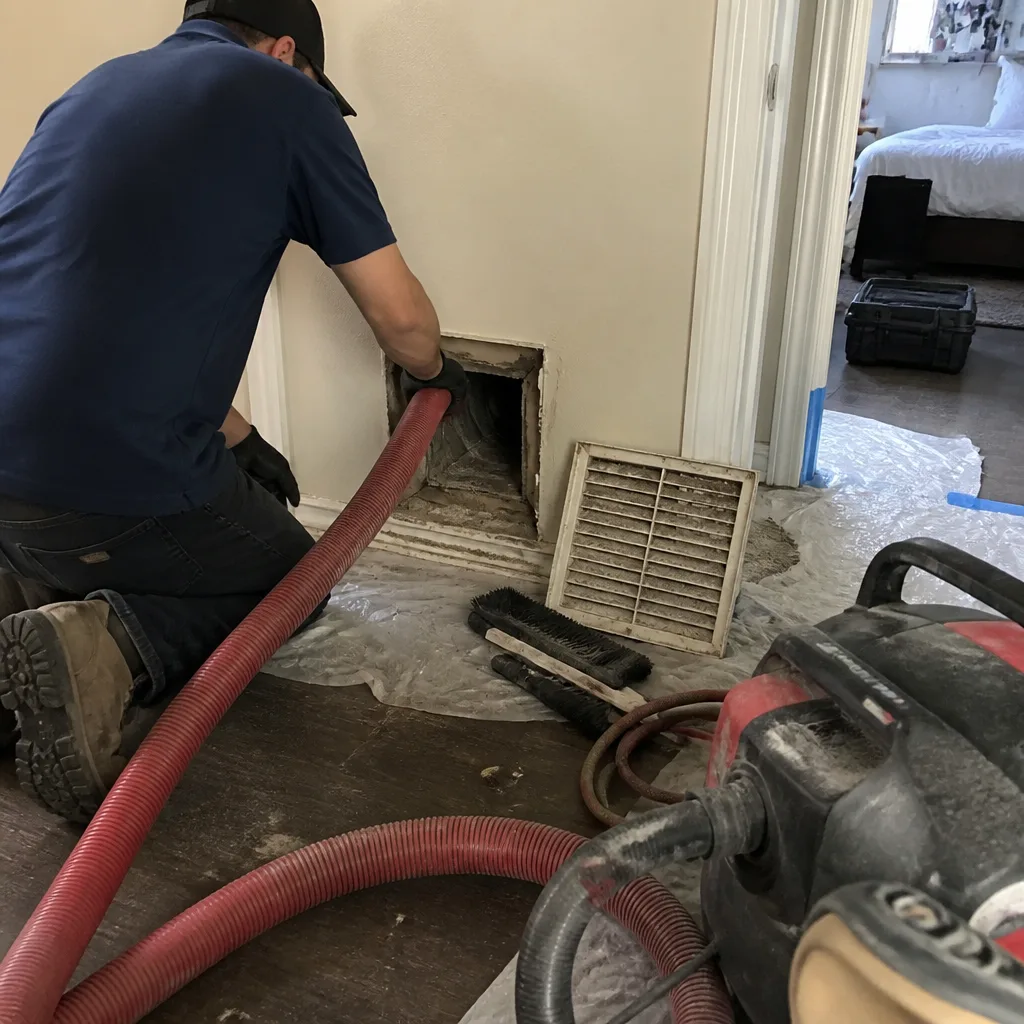 Before
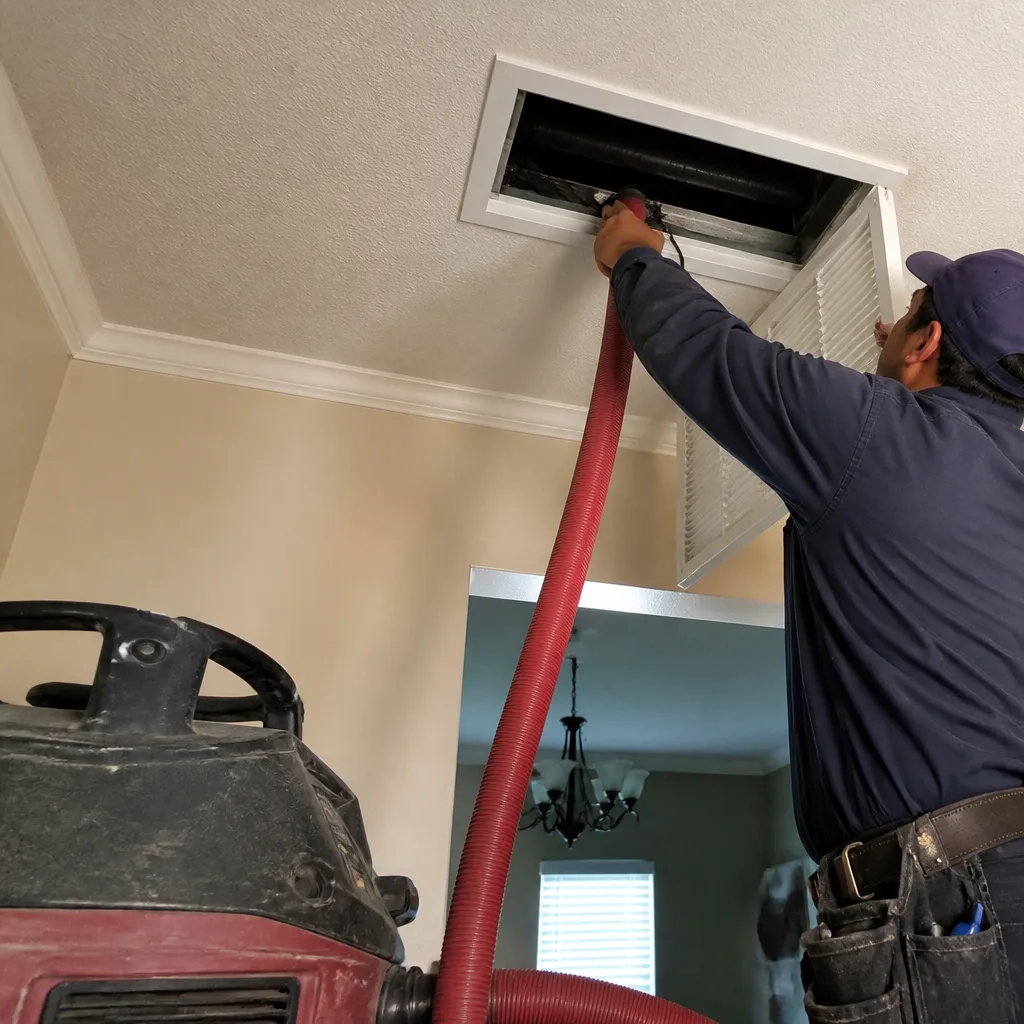 After
After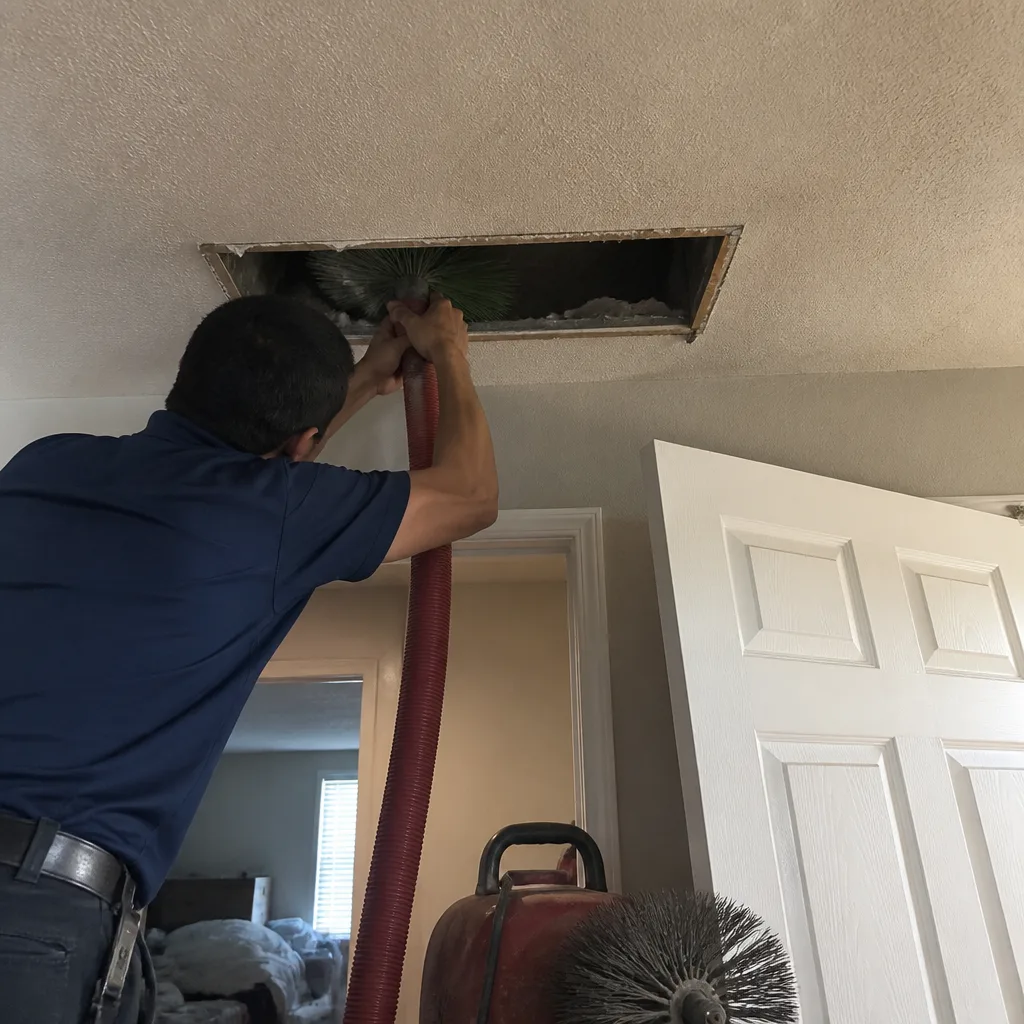 Before
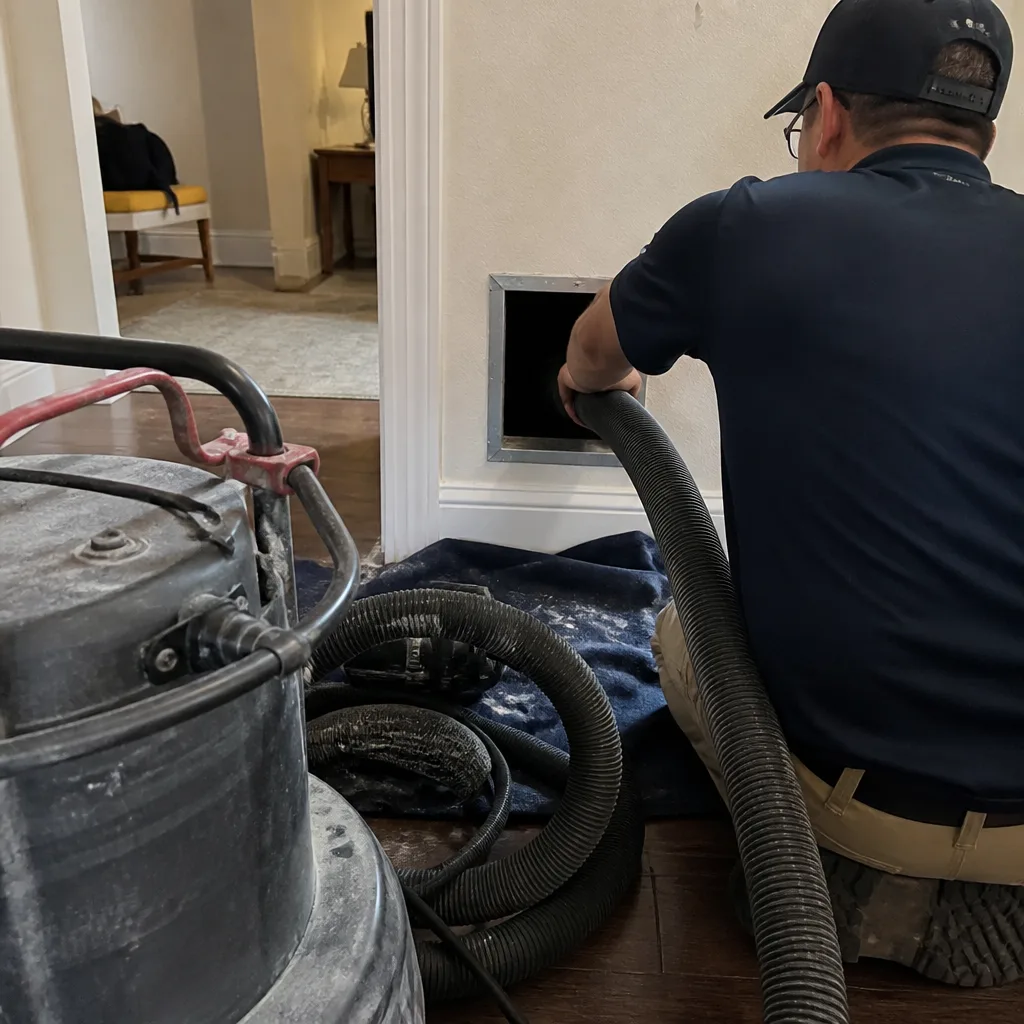 After
AfterThe Complete Guide to Air Duct Cleaning in Lewisville
A shop vac running for 45 minutes in your utility room sounds exactly like a $300 professional cleaning - because in roughly 40% of low-bid jobs, that’s all that happened. We’ve been in Lewisville homes where the homeowner paid for “complete duct cleaning” and the only evidence of entry was a single disturbed register in the hallway. The rest of the system - supply runs, return plenum, air handler cabinet - was untouched, and the debris was still there, just photographed from a different angle if it was photographed at all.
This guide shows you what a completed job actually looks like in measurable terms. You’ll learn how a duct system is structured, what debris patterns are common in Lewisville’s specific housing stock and climate, which cleaning methods remove debris versus redistribute it, and what documentation you should receive to prove the work happened. For DIY vs Professional Air Duct Cleaning: The Lewisville Homeowner’s Decision Guide, see our companion breakdown. If you know what to look for in the photos, you can’t be oversold.
Quick Answer
Professional air duct cleaning in Lewisville typically costs $350-$650 for a complete residential system, covers all supply runs, return plenums, and accessible air handler components, and should conclude with a documented photo record of every duct run before and after. The work takes 3-5 hours for a 2,000-square-foot home and should not be priced per vent. CleanRun Air Duct Cleaning Lewisville provides written upfront pricing before any work starts, with every job backed by our 365-Day Done Right Promise.
Table of Contents
- What Air Duct Cleaning Actually Means
- Debris Profiles Specific to Lewisville Homes
- Contact Vacuum vs. Negative-Pressure Extraction
- What “Clean” Looks Like in Documented Photos
- What Air Duct Cleaning Costs in Lewisville
- What Your Job Record Should Contain
- What 365-Day Accountability Means in Practice
- Common Mistakes to Avoid
- When to Call a Professional
- Frequently Asked Questions
BeforeAfterWhat Air Duct Cleaning Actually Means
Most homeowners picture a single tube running through their walls. A residential duct system is actually three distinct zones, and “duct cleaning” should specify which zones were accessed and which were skipped. Here’s the breakdown:
Supply runs - the individual tubes (usually flexible duct or galvanized steel) that carry conditioned air from the air handler to each room register. These are the components most people picture when they think of ducts. In Lewisville’s post-2015 construction, we commonly see flex duct runs of 15-25 feet with multiple elbows that trap debris at turns.
Return plenum and return ductwork - the larger chamber and ducting that pull air back to the air handler for reconditioning. The return plenum is typically a sheet metal box immediately adjacent to the air handler. Because return air moves more slowly and draws from larger spaces, this zone accumulates the heaviest debris loads. In slab homes near Lewisville’s older neighborhoods around Main Street and Mill Street, low return placement - sometimes less than 6 inches from the floor - pulls in more settled dust and pet dander than raised-floor designs.
Air handler cabinet - the metal enclosure containing the blower motor, evaporator coil, and heat exchanger. The blower wheel and coil fins are not technically “ducts,” but they’re part of the air path. A cleaning that stops at the ductwork and doesn’t address the blower compartment leaves the system’s largest debris reservoir untouched.
A complete job specifies all three zones in the written scope. A partial job cleans only the supply runs, or only the registers, or only what’s reachable without removing panels. The difference matters because debris migrates. Clean supply runs connected to a filthy blower wheel recontaminate within days.
Debris Profiles Specific to Lewisville Homes
Lewisville’s housing stock, climate, and geography create debris patterns that differ from Dallas to the south or Denton to the north. We’ve documented these patterns across 52,000+ homes since 2013, and the Lewisville-specific profiles are consistent enough to predict.
Construction Dust in Newer Subdivisions
Homes built 2015-2025 in subdivisions near Hebron Parkway, Castle Hills, and the 121 corridor often show heavy construction dust loading in the first 18-36 months of occupancy. This isn’t ordinary household dust. Drywall compound, insulation fragments, and concrete particulate from the building phase settle in duct runs during construction, then mobilize when the HVAC system runs continuously through its first Texas summer. In a 2022 job in a Lewisville home built in 2020 near the intersection of Hebron Parkway and Old Denton Road, our pre-cleaning photos showed a 2-inch accumulation of gray, fibrous material at the first elbow of a 20-foot supply run - material that proved to be a mixture of drywall dust and fiberglass insulation under microscopic examination.
The characteristic sign: registers that blow visible dust when the system first cycles on, even with a new filter installed. The debris is upstream of the filter, in the ductwork itself.
Pet Dander Stratification in Slab Homes
Lewisville has a high concentration of slab-on-grade construction, particularly in neighborhoods built between 1980 and 2005. In these homes, return air registers are often mounted at baseboard level or in the floor. Pet dander, being relatively light, remains airborne longer than heavier dust particles. But in homes with multiple pets and low returns, we see stratification: a dense layer of dander and hair at the bottom 15-20% of the return duct cross-section, with cleaner air passing above it. The system breathes around the debris rather than pulling it through.
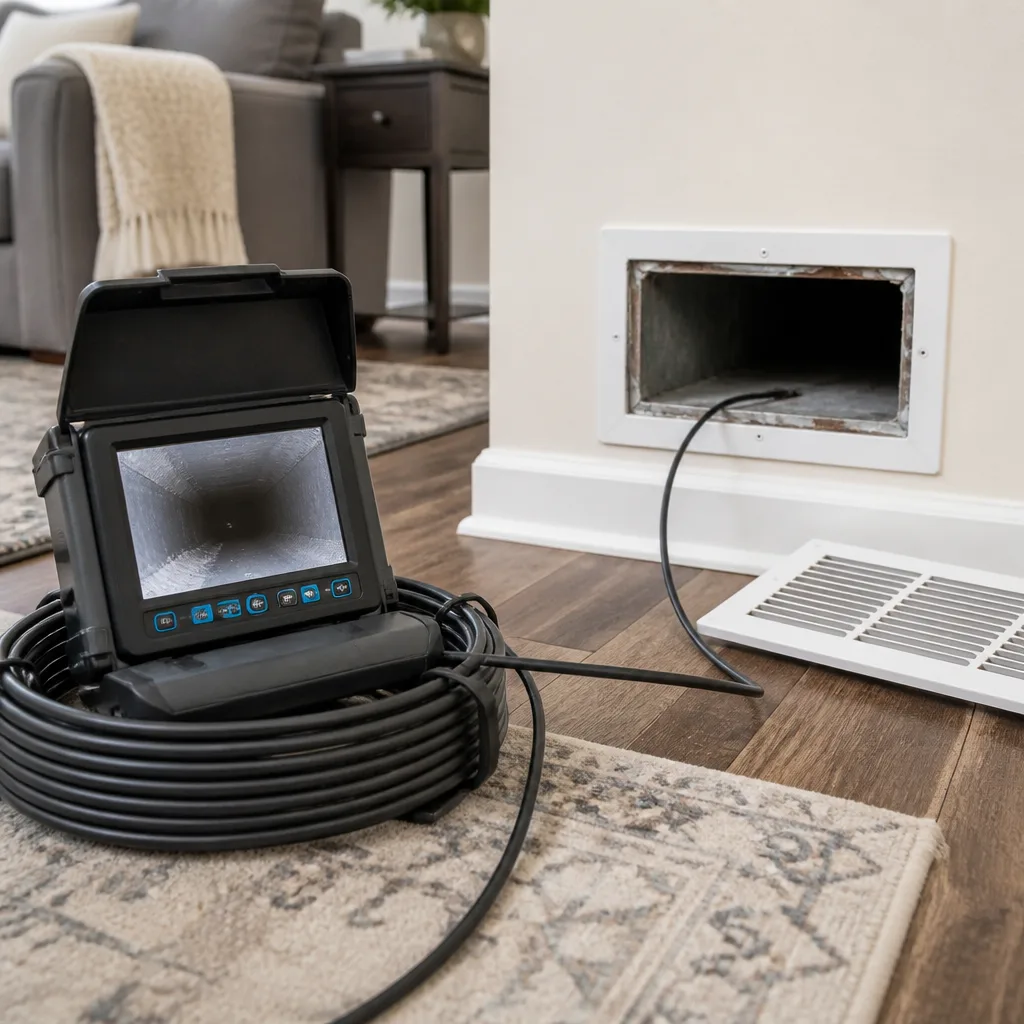
In a 2023 Lewisville home near Valley Ridge Boulevard with three indoor cats, our camera showed a mat of compressed hair and dander completely blocking the lower third of a 14-inch return duct. The homeowner had changed filters quarterly and reported “some dust” as the only symptom. The blockage had developed over approximately 4 years.
Mold-Adjacent Microbial Growth in High-Humidity Summers
Lewisville’s summer humidity routinely pushes 75-85% from June through September. When cool, conditioned air passes through duct runs in unconditioned attic spaces, condensation forms on the exterior of the ductwork. If the duct insulation is compromised - torn vapor barrier, compressed fiberglass - the interior surface can reach dew point. The result is not always visible mold, but rather a sticky, dark microbial film that traps subsequent dust particles and creates a self-sustaining accumulation zone.
We see this most often in Lewisville homes with attic ductwork and dark-colored shingle roofs, where attic temperatures exceed 130°F in July and August. The thermal stress degrades duct insulation faster than in homes with reflective roof surfaces or conditioned attics. The characteristic sign: registers with dark, tacky residue that smears when touched, rather than dry, powdery dust.
Contact Vacuum vs. Negative-Pressure Extraction
The method determines whether debris leaves your home or is simply redistributed. Here’s the distinction every homeowner should understand before hiring, and what our Air Duct Cleaning services address differently.
Contact Vacuum Cleaning
A technician inserts a vacuum hose with a brush attachment into each register and physically contacts the duct interior. This is the method used by most low-bid operators and coupon services. The equipment is typically a modified shop vac or a small portable unit.
Limitations: Contact vacuuming reaches only 6-10 feet from the register opening in most duct configurations. It cannot navigate elbows or transitions. It produces positive pressure at the vacuum head, which can force debris past the contact point rather than extracting it. And it provides no containment - disturbed debris that isn’t immediately captured re-enters the living space.
In Lewisville homes with long flex duct runs (common in post-2010 construction), contact vacuuming cleans perhaps 30-40% of the total duct length. The remainder is untouched.
Negative-Pressure Extraction with Whip Attachment
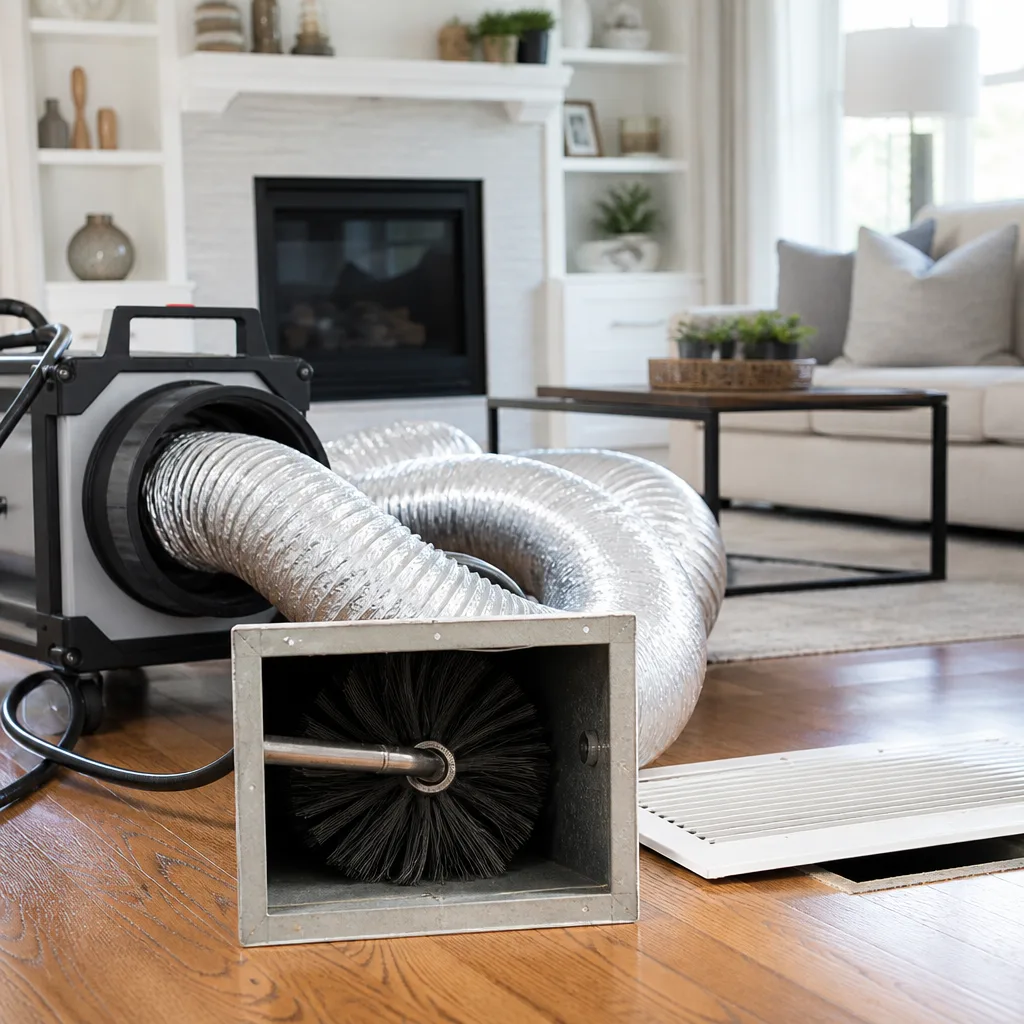
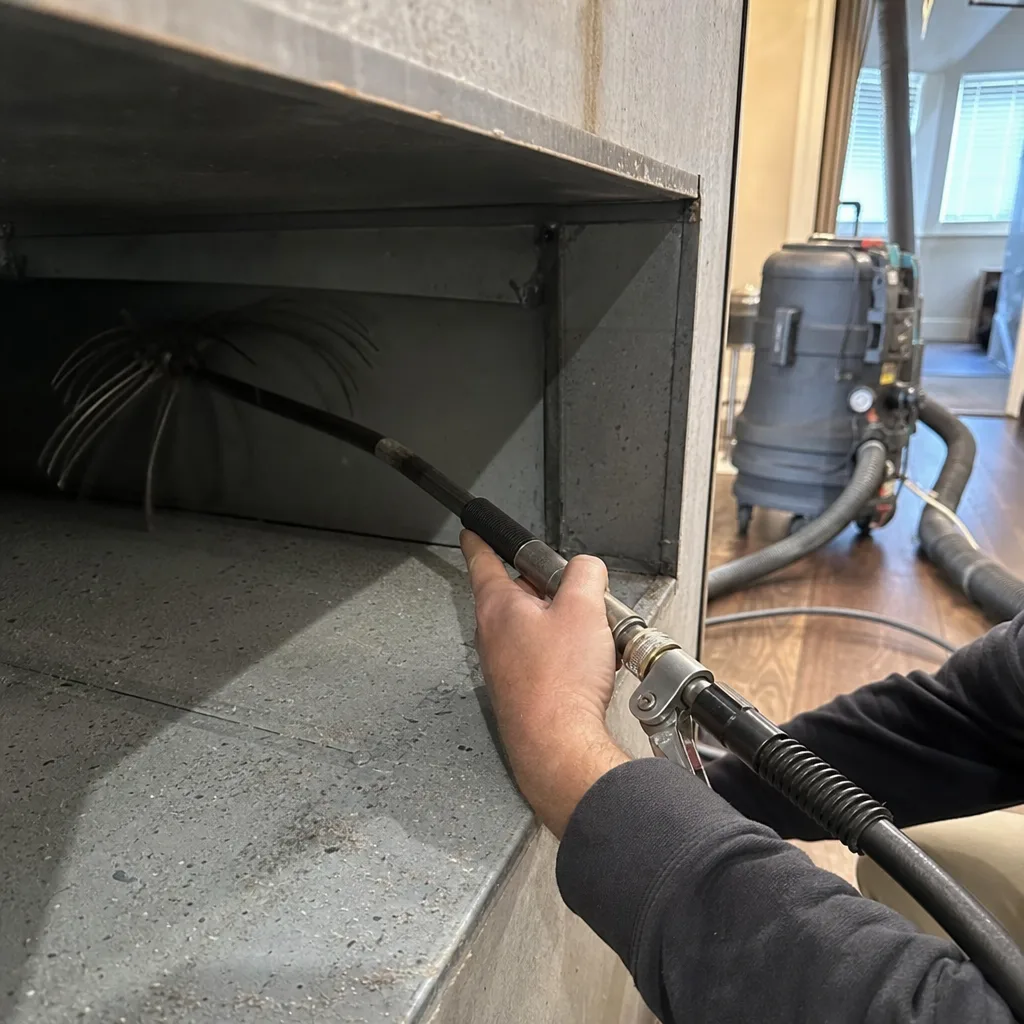
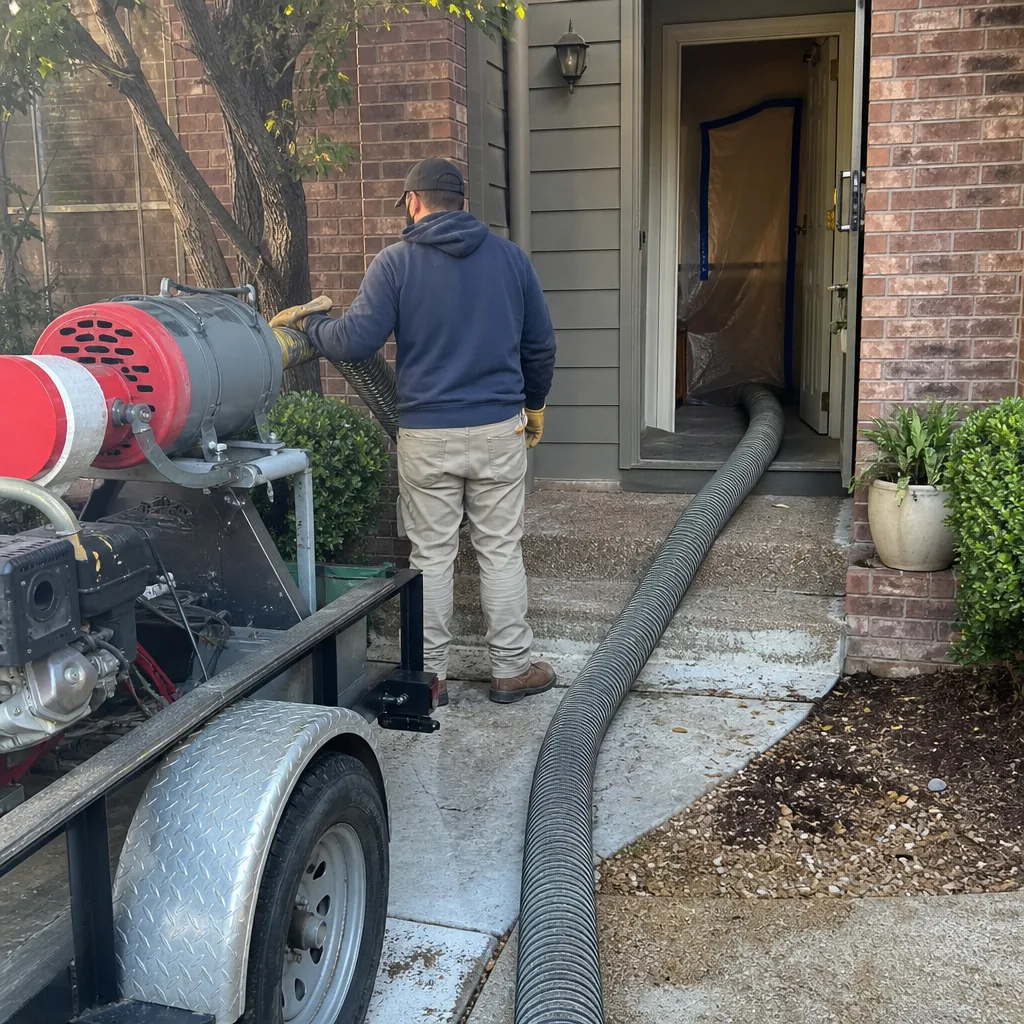
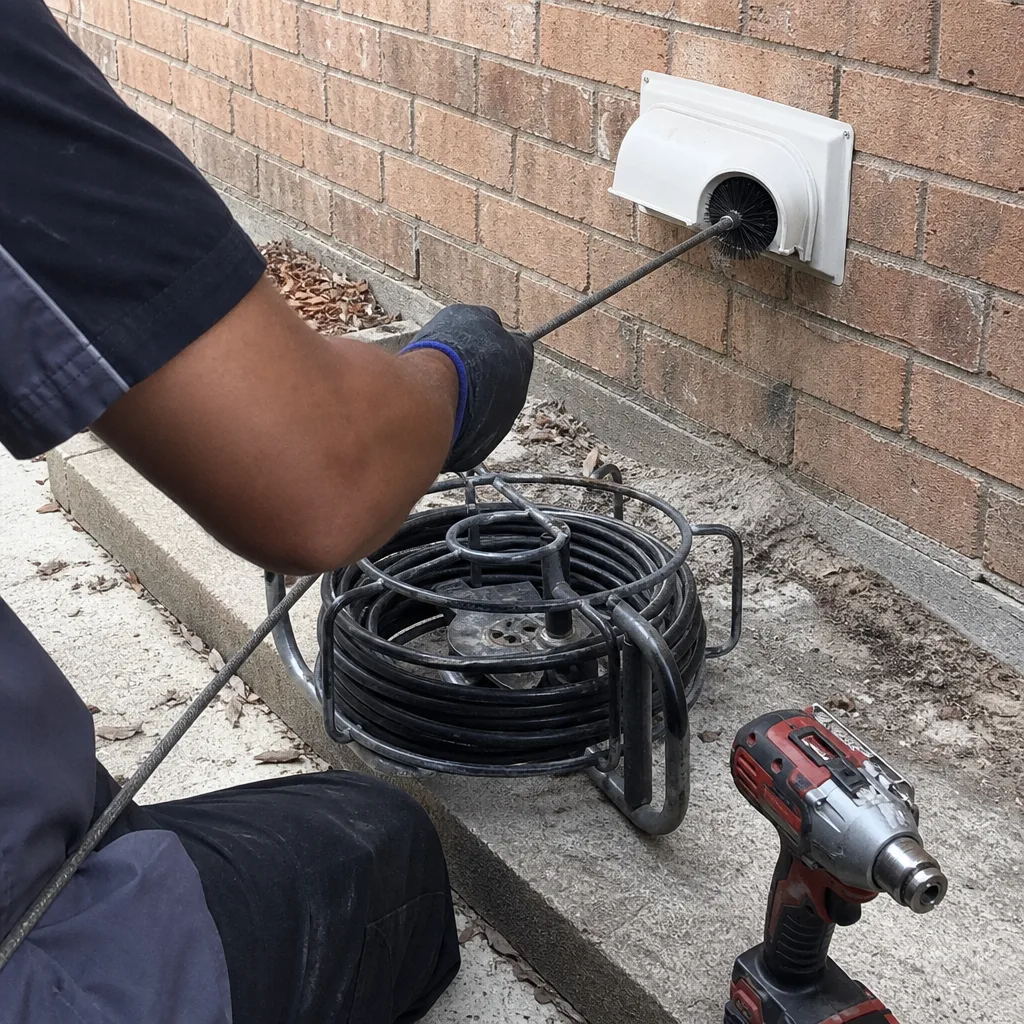
This method connects a high-volume vacuum (typically 5,000+ CFM) to the duct system near the air handler, creating negative pressure throughout the entire duct network. A separate access point allows insertion of a mechanical whip - a flexible shaft with nylon or rubber tentacles that flails at high RPM - which dislodges debris from duct walls while the vacuum pulls it continuously toward the collection point.
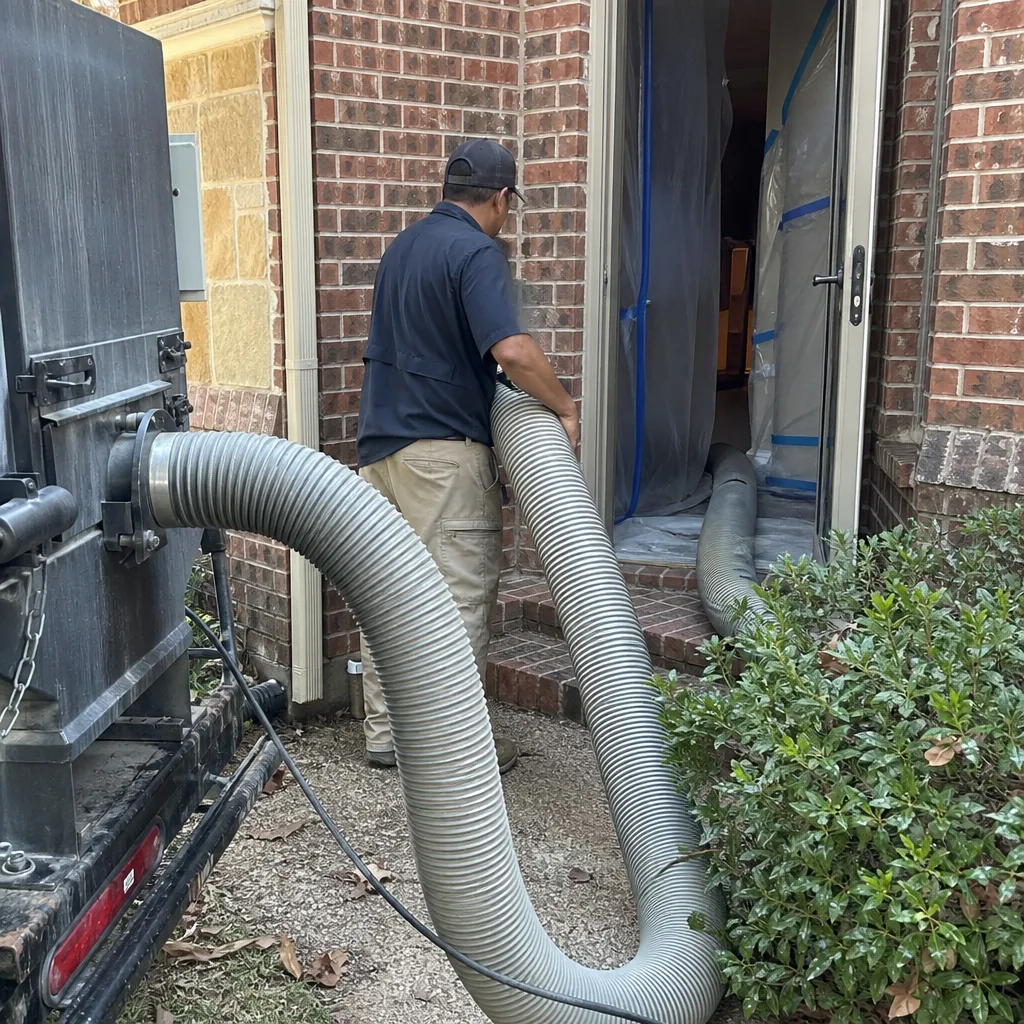
The critical difference: negative-pressure extraction cleans the full length of every duct run, including elbows and transitions, because the vacuum draws from the system core rather than pushing from the periphery. The containment is total - all dislodged debris is captured at the collection point, not released into the home.
Equipment we use for this method includes Abatement Technologies negative-air machines and Rotobrush portable extraction systems, selected based on home size and duct configuration. The equipment is specified in our written scope before work begins, under Haven Standard Clause 1.
How to Verify Which Method Was Used
- Ask for the equipment manufacturer and model in writing before agreeing to a price. A shop vac has a manufacturer and model too - the distinction matters.
- Request photos showing the vacuum connection point. Negative-pressure extraction requires a visible duct cut or access panel near the air handler. No access panel means no negative-pressure extraction.
- Ask for pre- and post-cleaning static pressure readings if accessible. Negative-pressure extraction typically reduces static pressure by 10-25% in debris-loaded systems. Contact vacuuming produces negligible change.
What “Clean” Looks Like in Documented Photos
Without a reference standard, “clean” is whatever the technician says it is. We’ve developed a measurable definition based on 52,000+ documented photo records. Here’s what to look for in your own job record.
Photo Documentation Standards
Every duct run should be photographed at two points: at the register opening (showing the boot and first 2-3 feet of duct), and at a mid-run access point or elbow if physically accessible. Photos should be tagged by register location - “Master bedroom, north wall” rather than “Photo 7 of 12.”
The before photo should show:
- Visible debris on duct walls, with enough resolution to distinguish dust from construction residue from microbial growth
- Register boot condition, including any standing debris or staining
- Duct interior color - galvanized steel should appear metallic, flex duct should show fabric texture without gray or black coating
The after photo should show:
- Same camera angle and lighting as the before photo
- Metallic or fabric surface visible without coating
- No visible debris accumulation at elbows or transitions
- Register boot free of staining and standing material
What “Not Clean” Looks Like
We’ve reviewed competitor photo records brought in for Free Second Opinions. Common failures: photos shot at different angles so debris shadows are hidden; photos of only the register boot while the duct run itself is omitted; photos with flash glare obscuring duct walls; “after” photos that are actually pre-cleaning photos from a different register. The 2023 Lewisville home with the cat dander mat - the homeowner’s previous service had provided 14 photos of register boots, zero of duct interiors, and claimed “complete cleaning.”
Our standard: every photo record delivered to the customer includes minimum 4 photos per zone (supply, return, air handler), tagged by location, with before/after pairs matched by angle. This has been our practice since our first job in 2013.
What Air Duct Cleaning Costs in Lewisville
Honest pricing for a complete residential system in Lewisville falls in a narrower range than most homeowners expect. The variation comes from system size and accessibility, not from mysterious “per vent” calculations that inflate at the door. For vetting providers, read How to Hire a Air Duct Cleaning Contractor in Lewisville: A Step-by-Step Guide.
| System Type | Typical Range | What Affects Price |
|---|---|---|
| Small home (1,200-1,800 sq ft), single system, accessible attic | $350-$450 | Duct material (flex vs. metal), number of returns |
| Mid-size home (1,800-2,800 sq ft), single system | $450-$550 | Attic temperature/access, presence of UV light or electronic air cleaner |
| Large home (2,800-4,000 sq ft), single or dual system | $550-$650 | Dual systems, zoning dampers, extensive flex duct |
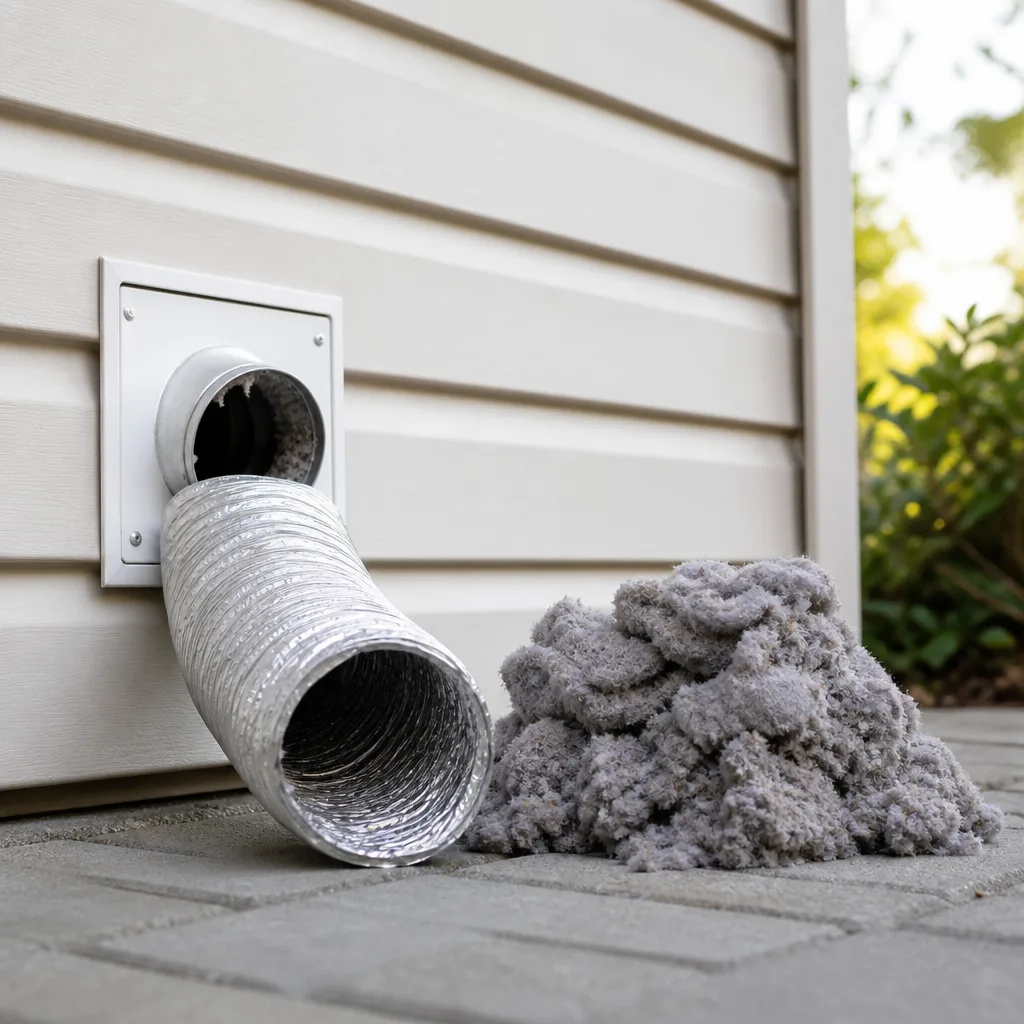
| Additional services: dryer vent cleaning, coil cleaning, sanitizing | $75-$150 per service | Dryer vent length and termination type, coil accessibility |
Factors that legitimately increase price: systems with more than 2 returns, ductwork in conditioned vs. unconditioned spaces (attic work in July adds time), and systems requiring access panel installation where none exists. Factors that should not increase price: “surprise” per-vent charges, “required” sanitizing upsells, or equipment fees not disclosed in the written scope.
Our pricing is governed by Haven Standard Clause 1: Written Price Before Any Work Starts. The price you approve in writing is the price on the invoice. No exceptions. Dryer vent cleaning in Lewisville can often be bundled with duct cleaning for reduced combined pricing.
What Your Job Record Should Contain
The job record is the only proof you have that work occurred. A verbal assurance or a receipt for payment is not a job record. Here’s what a complete record includes, and why each element matters for accountability.
Written Scope Preceding Price
Before any panel is removed, you should receive a document specifying: which zones will be cleaned (supply runs, return plenum, air handler cabinet), which equipment will be used (manufacturer and model), how many access points will be created and how they’ll be sealed, and the total price. This is not an estimate. It’s a fixed scope with a fixed price. If the technician discovers a condition that genuinely changes scope - a collapsed duct, for example - the additional work requires a separate written authorization.
Duct Count and Location Map
The record should list every register and return by room location, with a checkmark or initial confirming each was accessed. This prevents the common shortcut of cleaning only visible or easily reached registers. In a typical Lewisville home, we document 8-14 supply registers and 1-3 returns.
Before-and-After Photos Tagged by Register
As described above: matched pairs, tagged by location, with enough resolution to evaluate cleaning quality. These photos are delivered as part of the standard job record, not held hostage for a review or additional fee.
Static Pressure Readings (If Accessible)
Not all systems have accessible test ports, but when they do, pre- and post-cleaning static pressure measurements provide objective evidence of improved airflow. A significant reduction in static pressure (10-25%) indicates debris removal. Minimal change suggests superficial cleaning or a system with non-debris airflow restrictions.
Written Warranty Documentation
Our 365-Day Done Right Promise is printed, signed, and delivered with every job record. It specifies: what constitutes a callback (visible debris in photos, recurrence of pre-cleaning symptoms, measurable airflow reduction), what we do in response (return visit, re-cleaning, or refund if work was not performed as scoped), and the timeline (response within 48 hours, resolution within 5 business days). Haven Standard Clause 6: Documented Accountability.
What 365-Day Accountability Means in Practice
Most duct cleaning warranties are verbal, limited to 30 days, or contingent on “satisfaction” as judged by the company. Here’s what a meaningful accountability promise looks like, and what triggers it.
What Triggers a Callback
We honor callbacks for three specific conditions, documented in writing: visible debris in any duct run that was photographed as clean, recurrence of pre-cleaning symptoms (dust emission at registers, reduced airflow at specific rooms, odor) within the warranty period, and failure of any sealed access point or repair performed during the original scope.
We do not honor callbacks for: new debris accumulation from continued occupancy (normal household dust), symptoms caused by unrelated HVAC failures (blower motor failure, refrigerant leak), or filter neglect. The distinction is important. Accountability for our work is not a blanket maintenance guarantee.
What Happens After a Callback Request
The homeowner calls (940) 240-8552, speaks to a live person (24/7 answering, per Haven Standard Clause 2), and describes the concern. We review the original job record - photos, scope, technician notes - within 24 hours. If the concern matches a covered condition, we schedule a return visit within 5 business days. The technician is identified by name before arrival, background-checked and uniformed, per Haven Standard Clause 3: Verified Crews.
At the return visit, we re-photograph the affected areas and compare to the original record. If the work was not performed as scoped, we re-clean at no charge or refund the original payment, at the homeowner’s election. If the original work was performed correctly and new conditions have developed, we explain the findings and offer a new scope if additional work is appropriate.
Why the Absence of a Written Promise Is Data
A contractor who will not put accountability in writing is communicating something. The cost of honoring legitimate callbacks is built into honest pricing. The alternative is pricing that assumes no callbacks - which means either the work is performed so superficially that callbacks are rare, or the contractor intends to be unreachable when problems arise. In 12 years of operation, our callback rate is under 3%, and every one has been resolved under the written terms.
Common Mistakes to Avoid
- Booking by price alone. The $79-$149 coupon services in Lewisville typically clean only register boots and the first few feet of duct, or use contact vacuuming that redistributes debris. The real cost is paying twice, or living with degraded air quality you mistakenly believe was addressed.
- Accepting per-vent pricing. Per-vent pricing incentivizes the technician to find “extra” vents, reclassify returns as supplies, or skip difficult runs. Whole-system pricing with a written scope eliminates these games.
- Neglecting the air handler. A cleaning that stops at the ductwork and doesn’t address the blower wheel and coil leaves the system’s largest debris reservoirs untouched. Verify the scope includes the air handler cabinet.
- Skipping photo documentation. Without photos, you have no evidence of what was or wasn’t cleaned. Demand tagged before/after pairs as a standard deliverable, not an upsell.
- Ignoring Lewisville-specific construction issues. Newer homes near Hebron Parkway with construction dust loading, slab homes with low returns near Mill Street and Main Street, and attic ductwork in summer heat all require method adjustments. A technician who treats every home identically is not performing customized work.
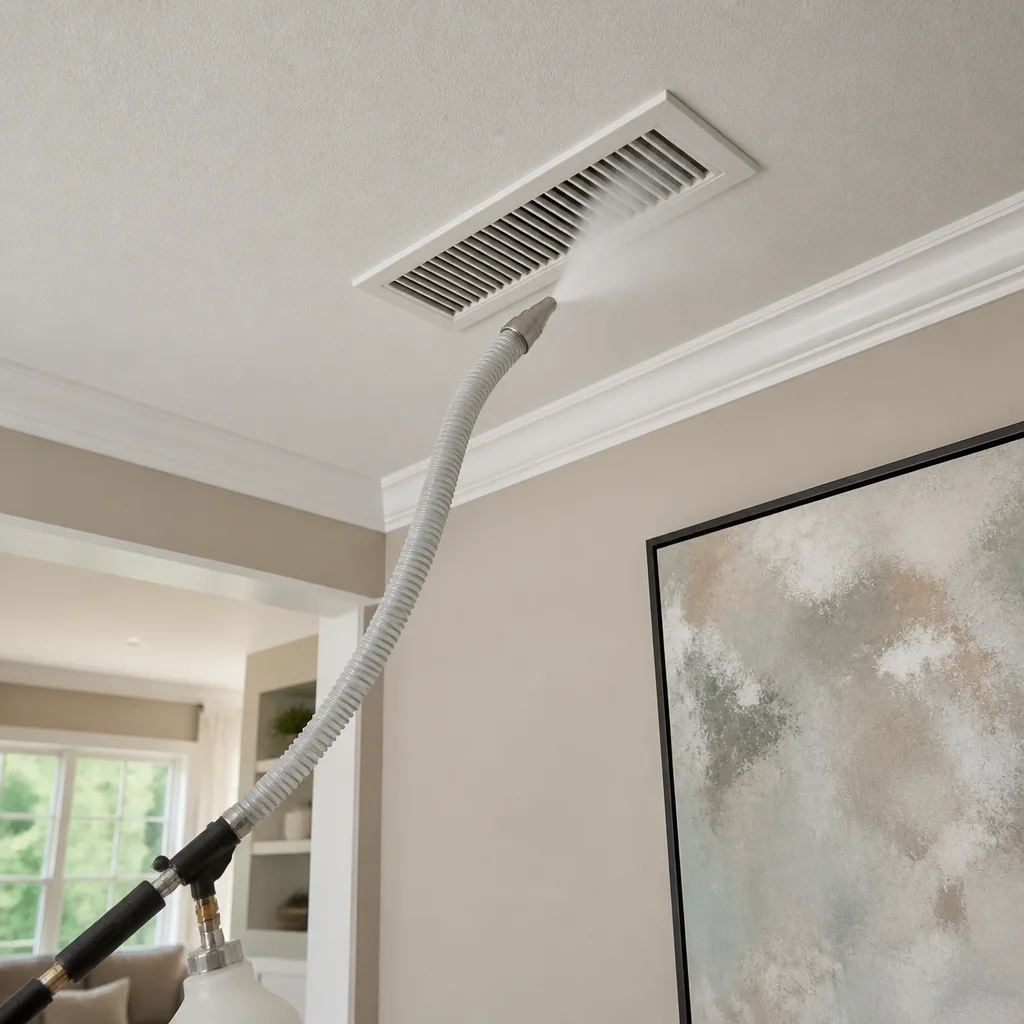
- Confusing sanitizing with cleaning. Sanitizing (applying antimicrobial agent) is a separate service from debris removal. It cannot substitute for cleaning, and in some cases is unnecessary if the underlying debris is removed. Never accept sanitizing as an upsell to compensate for inadequate mechanical cleaning.
When to Call a Professional
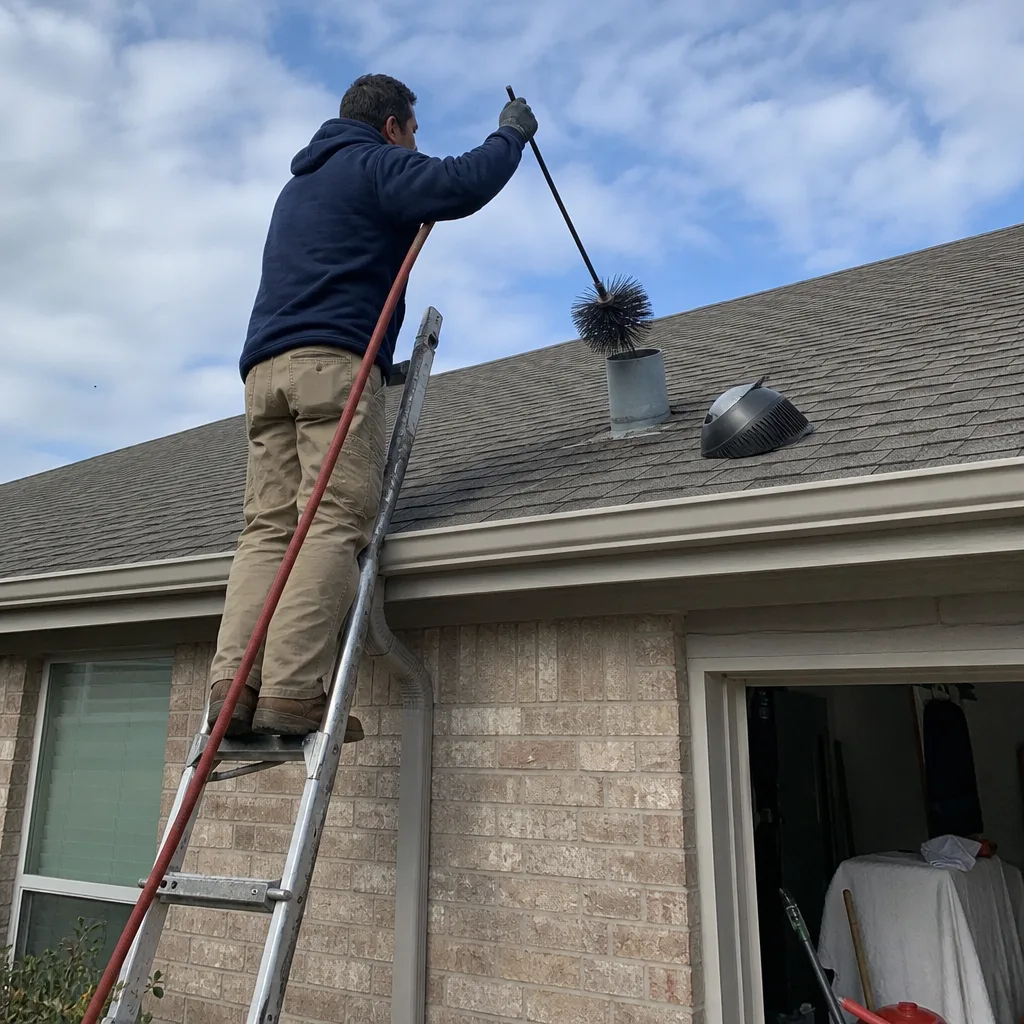
Call for an evaluation when you observe visible dust emission at registers when the system cycles on, persistent room-to-room temperature variation that filter changes don’t resolve, musty or stale odors that localize to specific registers, or debris visible at register openings that returns after cleaning. In Lewisville’s climate, microbial growth in attic ductwork often announces itself as a seasonal odor that intensifies in August and September when humidity peaks. Browse more guides & resources on protecting your home’s air quality.
Don’t wait for an emergency. Duct cleaning is scheduled maintenance, not urgent repair, and the best outcomes come from planned evaluation rather than reactive hiring. CleanRun Air Duct Cleaning Lewisville offers free estimates in Lewisville - call (940) 240-8552. We’ll provide a written scope and fixed price before any work starts, with no obligation to proceed. HVAC cleaning in Lewisville can be evaluated simultaneously if your system hasn’t been serviced comprehensively.
Frequently Asked Questions
Complete residential air duct cleaning in Lewisville typically costs $350-$650 depending on home size and system accessibility. Small homes with single systems and accessible attics fall at the lower end; larger homes with dual systems or difficult attic access fall at the higher end. The price should be a fixed whole-system rate, not per-vent. Call (940) 240-8552 for a written estimate with no obligation - estimates are free.
Low quotes typically reflect partial scope: register cleaning only, contact vacuuming that reaches only a fraction of duct length, or equipment that redistributes rather than extracts debris. The $79-$149 range in Lewisville marketplaces almost always excludes the return plenum and air handler, and often uses unverified subcontractors rather than uniformed, background-checked technicians. The real cost difference is between documented work and vacuum noise.
Demand a job record with before-and-after photos tagged by register location, a written scope that preceded the price, and a duct count confirming every run was accessed. Without these, you have only the technician’s word. CleanRun has delivered documented photo records on every job since 2013 - it’s standard, not optional.
Most Lewisville homes benefit from cleaning every 3-5 years under normal occupancy. Homes with multiple pets, recent construction, or residents with respiratory sensitivities may need more frequent service. Newer homes near Hebron Parkway and Castle Hills with construction dust loading often need an initial cleaning at 18-36 months, then settle into a longer interval. The best indicator is a visual inspection with a camera, not a calendar.
Moderately, in specific conditions. If your ducts are heavily loaded with debris, cleaning can reduce static pressure and improve airflow, which reduces blower motor workload. The savings are typically 5-15% of HVAC energy consumption in debris-restricted systems, not the dramatic claims some marketers make. Duct sealing and insulation repairs often yield larger efficiency gains than cleaning alone.
Usually not. Sanitizing applies antimicrobial agents to duct surfaces, but if mechanical cleaning has removed the debris that supports microbial growth, the biological food source is gone. We recommend sanitizing only when: visible microbial growth was present and physically removed (sanitizing treats residual spores), or a household member has specific immunocompromised status requiring additional precaution. We do not upsell sanitizing to compensate for incomplete mechanical cleaning.
The Bottom Line
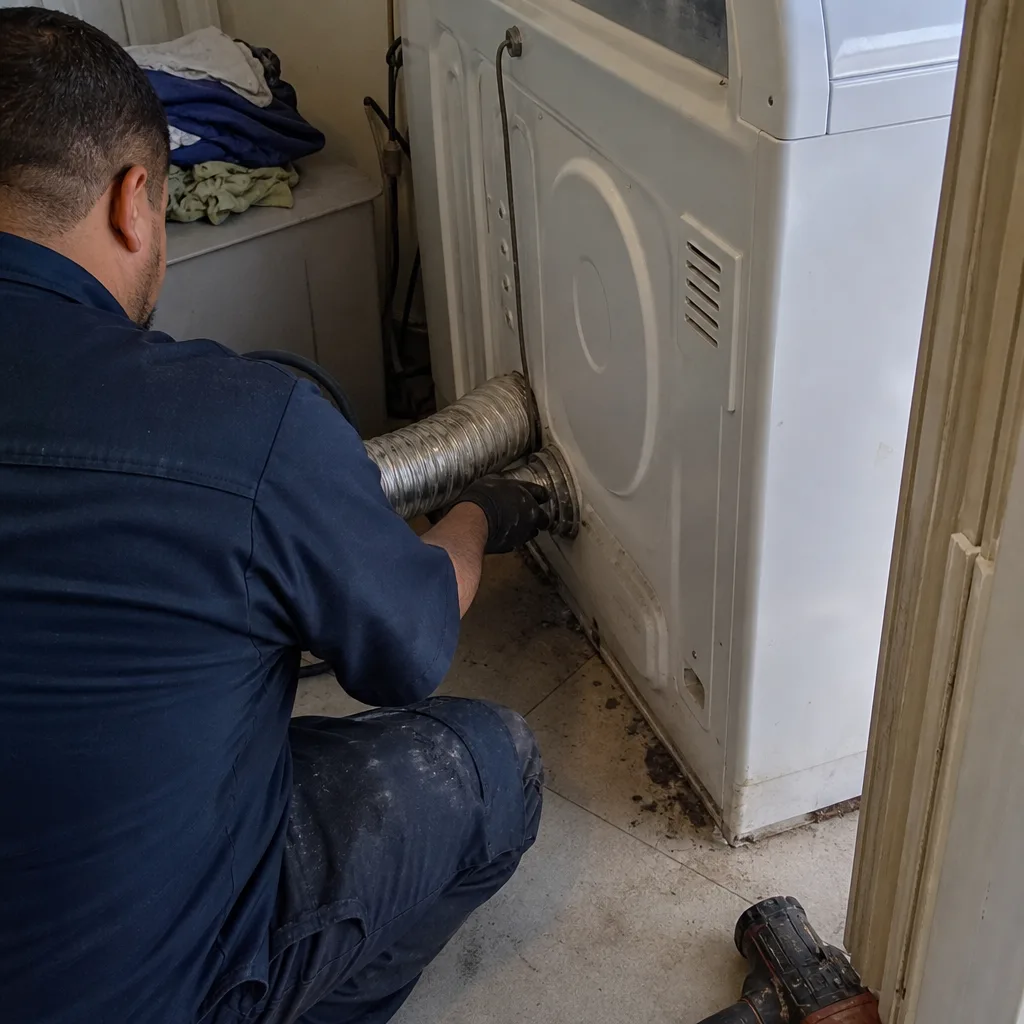
Air duct cleaning in Lewisville is a service you can evaluate objectively if you know what to request. Define the full system scope - supply runs, return plenum, air handler cabinet. Understand the method - negative-pressure extraction with whip attachment, not contact vacuuming. Demand documentation - tagged photos, written scope, fixed price, written warranty. Know your home’s specific debris profile based on age, construction type, and neighborhood. And hold out for accountability in writing, not as a verbal promise that evaporates with the technician’s van.
The industry has trained homeowners to shop by price and hope for honesty. The better approach is to shop by evidence and eliminate the guesswork. If a contractor cannot show you what clean looks like before you buy, they cannot show you what clean looks like after they’ve been paid.
Written by Tomas Reyes, Owner at CleanRun Air Duct Cleaning Lewisville, serving Lewisville since 2013.